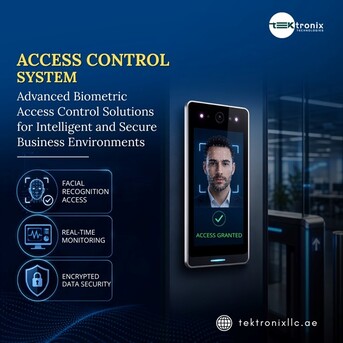
How Access Control System Reduces Security Risks In UAE
📍 Dubai
🕐 3 months ago
👁 7,563 views
AED 0
Description
Every security incident that occurs in a UAE facility - an after-hours intrusion, a data breach facilitated by physical access, a terminated employee returning with a still-active card, or a contractor moving beyond their authorised area - traces back to a gap in the Access Control System protecting that facility. Access control is not simply a door-locking mechanism: it is the primary physical security risk reduction framework that governs who can be where, when, and under what verification conditions - and its design quality determines the gap between a facility's security policy and its security reality. Tektronix LLC, a SIRA-licensed, ISO 9001:2015 and ISO/IEC 27001:2022 certified integrator with over 500 UAE and GCC deployments since 2009, maps specific UAE facility security risks to the access control capabilities that eliminate them - delivering Access Control Solutions that reduce measurable risk rather than simply adding technology. Risk 1: Credential Sharing and Buddy-Punching - Eliminated by Biometric Verification The most pervasive physical security risk in UAE facilities is not sophisticated external intrusion - it is the routine internal practice of credential sharing: employees lending access cards to colleagues, workers clocking each other in at attendance terminals, contractors sharing PIN codes across team members, and temporary staff using borrowed credentials to access zones above their authorisation tier. A conventional card-only Advanced Access Control System cannot detect this because it verifies that a valid credential is present, not that the enrolled individual is personally presenting it. Tektronix LLC eliminates credential sharing risk through Biometric Access Control Dubai deployments - fingerprint, facial recognition, or iris recognition verification that binds every access event to the physical presence of the specific enrolled individual. As a Suprema Certified Installer, HID Global Authorised Dealer, and ZKTeco Partner, Tektronix LLC selects the optimal biometric modality for each application: contactless facial recognition for high-throughput lobby turnstiles where speed is paramount, fingerprint for server room and vault access where individual accountability must be absolute, and multi-factor combining both for the highest-security zones where no single-factor compromise is acceptable. Risk 2: Credential Overhang - Eliminated by Automated Lifecycle Management Every UAE organisation experiences staff turnover, contractor rotation, and role changes - and in every case where access credentials are not promptly updated or revoked, a security risk accumulates silently. A departed employee whose smart card was never deactivated, a contractor whose permit expired but whose building access remains active, or a transferred employee whose previous department's access was never removed - these are credential overhang scenarios that routinely appear as the primary enabling condition in UAE facility security incident investigations. Tektronix LLC's Security Access Control System deployments address this through HRMS integration -connecting the access control platform to the organisation's SAP, Oracle, or Microsoft Azure Active Directory system so that employment termination and role change events automatically trigger access right modification within a configurable timeframe, typically within 15 minutes of the HR system event. SIRA compliance audits and ISO/IEC 27001:2022 internal reviews consistently identify credential overhang as the most frequent physical access control finding - Tektronix LLC's automated lifecycle management eliminates it by removing the human dependency that creates the gap. Risk 3: Tailgating and Piggybacking - Eliminated by Physical Barrier Enforcement Tailgating - one unauthorised individual following an authenticated person through a secured door before it closes - is the simplest and most commonly successful physical security bypass technique in UAE commercial and institutional environments. No amount of camera coverage or security officer vigilance reliably prevents tailgating at busy entry points during peak arrival and departure periods; only a physical enforcement mechanism at the door can guarantee single-person passage for every credential event. Tektronix LLC integrates Door Access Control System hardware with anti-tailgating technology at high-risk entry points - turnstile speed gates at lobby access points enforcing single-person mechanical passage, door position sensors detecting extended door-open events that indicate a held door, and optical beam sensors at controlled doorways alerting on dual-body detection within a single credential event window. For UAE banking, government, and data centre environments where a single tailgating event at the wrong boundary can compromise a controlled zone, this hardware-level enforcement is the only reliable risk mitigation - policy and signage demonstrably are not. Risk 4: Unauthorised Zone Access - Eliminated by Role-Based Policy Architecture A credential that grants building entry should not automatically grant access to every zone within that building. An IT contractor who needs server room access has no business justification for finance floor access; a reception visitor who has been escorted to a meeting room has no authorisation for the back-of-house corridor. When zone permissions are not explicitly defined and enforced, every individual with building access represents a potential zone breach - an insider threat risk that the organisation has inadvertently created through architectural permission gaps. Tektronix LLC configures every Access Control Device deployment with role-based zone permission matrices - each credential carries only the zone permissions explicitly required for the enrolled individual's current role, and the controller enforces these permissions at the hardware level without server dependency. Zone permissions are reviewed as part of the quarterly access rights audit that Tektronix LLC includes in every AMC, identifying permission scope creep - individuals who have accumulated access rights beyond their current role requirement - and generating a remediation list for the security team to action before the accumulated risk materialises into an incident. Conclusion An Access Control System is the UAE facility's primary physical security risk reduction framework — and every gap in its design, configuration, or lifecycle management represents a measurable and exploitable security vulnerability waiting for the wrong person or event to expose it. Deploying an Advanced Access Control System with HRMS-integrated credential lifecycle management eliminates the credential overhang risk that even well-intentioned manual processes consistently fail to prevent - ensuring that every departure, role change, and permit expiry translates immediately into an access right update. Biometric Access Control Dubai deployments eliminate credential sharing and buddy-punching risk by binding every access event to the enrolled individual's biometric presence, while Security Access Control System cybersecurity hardening ensures the access control platform itself cannot be exploited as a network attack vector. Anti-tailgating Door Access Control System hardware enforces single-person mechanical passage at every critical boundary, and role-based Access Control Device

Similar Ads
Expert Laptop & Desktop Repairing Dubai – Same-Day Fix
Call for Price
 📷 2
📷 2
Marhaba Advertising
AED 333
💻
iPad Screen Repair Dubai | Professional Apple Repair
AED 223

Become a Full Stack Developer with Java Training in Bangalore!
AED 0

Data Analytics Training in Bangalore | Learnmore Technologies
AED 0

Data Science Training in Bangalore | Learnmore Technologies
AED 0
🛡️ Stay Safe
- ✓ Meet in a public place
- ✓ Inspect before paying
- ✓ Never pay in advance